
Get Local Business Clients Fast Using AI (Full System)
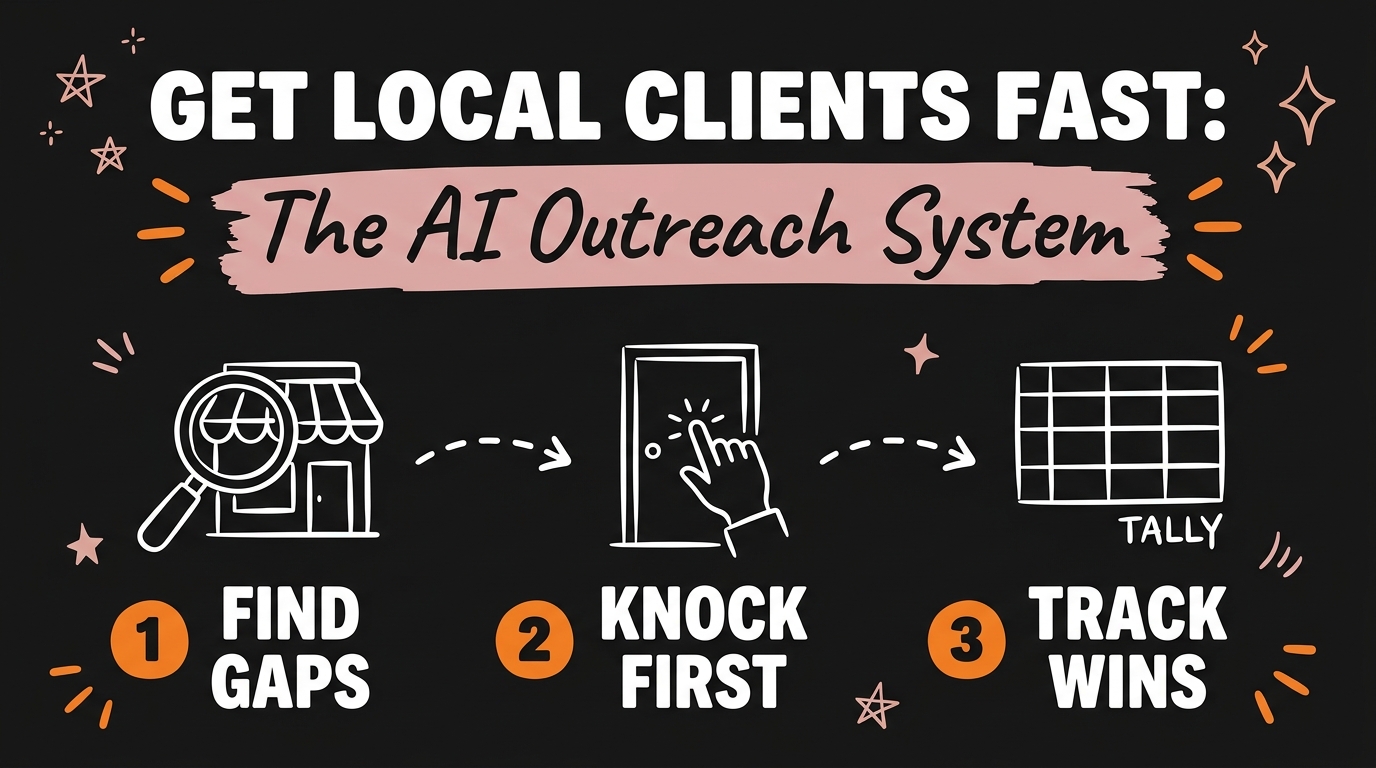
The fastest way to get your first paying client is not another week of posting online — it is walking into a local business with a specific gap you already spotted. Local businesses decide faster, pay faster, and care far less about your follower count than any online client ever will. With Claude doing the research, you can go from “no leads” to a table of local businesses with missing pieces and phone numbers in about two minutes.
Most entrepreneurs get this backwards. They spend months polishing an online presence for clients who never arrive, while the plumber, the bakery, and the dental clinic ten minutes away all have broken Google listings and no one to fix them.
Get the Free Guide
The Local Client Outreach Playbook packs the full system — the lead-list prompt, realistic outreach targets, the sheet CRM, and a local events pipeline — into one printable cheat sheet.
Get the free Local Client Outreach Playbook →
Why Do Local Businesses Pay Faster Than Online Clients?
Local businesses pay faster because the trust barrier is lower and the competition is thinner. Online, you are one of ten thousand freelancers in a feed. Locally, you might be the only person who has ever shown the owner exactly what is missing from their online presence. You are also selling to someone who can shake your hand — which shortcuts weeks of “building authority” into a single conversation.
The other advantage is speed of decision. A business owner staring at a broken Google Business Profile does not need a nurture sequence. They need someone standing in front of them who can fix it this week.
How Do You Build a Local Lead List With One Claude Prompt?
One prompt turns Claude (Anthropic’s AI assistant) into your lead researcher: it finds businesses in your niche, audits their online presence, flags what is missing, and pulls contact details into a table. Here is the exact prompt:
1
2
3
Find businesses in this category within my town. For each one, check their
online presence. [offer action] Flag the ones that are clearly behind. Give
me a table with the business, what's missing, and how to contact them.
Swap [offer action] for whatever you sell — “check if they have a booking page,” “look at their review response rate,” “see if their menu is online.” Two minutes later you have a table of leads with gaps and phone numbers, sorted by who needs you most.
That gap column matters more than the contact column. It is your opening line: “I noticed your booking link is broken” beats “I do web design” in every conversation you will ever have.
What Is the Best Outreach Method for Local Clients?
In-person visits get the fastest yes, phone calls are second, and email is a distant last. That ranking feels backwards to anyone used to online work, but it mirrors the trust dynamics: the harder the channel is to fake, the faster it converts.
| Method | Speed to “yes” | Best for |
|---|---|---|
| Door to door | Fastest | Retail, restaurants, clinics — anywhere with a front desk |
| Phone call | Second | Trades and offices you cannot walk into |
| Slowest | Follow-ups and sending the recap after a visit |
Instead of guessing how much outreach is enough, have Claude build your schedule around the hours you actually have:
1
2
3
4
5
I'm doing cold outreach to local businesses to land my first client. I can
spend [X hours] per week on it. Give me a realistic daily and weekly target
for outreach attempts across in person visits, calls, and emails, and a
realistic number of conversations and yeses I should expect from that
volume as a beginner. Keep it honest, not hype.
The “keep it honest” line is the important part — you want a target you can hit on a bad week, not a fantasy number that makes you quit by Thursday.
How Do You Track Outreach Without a Real CRM?
You do not need a CRM subscription — a Google Sheet built from your own notes is enough for your first fifty conversations. Snap a photo of your notes after each day of outreach and let Claude structure it:
1
2
3
4
Here's a screenshot of my outreach notes. Turn this into a simple tracker
with columns for business name, contact method, date contacted, response,
and next step. Give me a running tally of attempts, conversations, and
yeses so I can see my progress like a scoreboard.
The scoreboard framing is deliberate. Early outreach is a numbers game, and watching your attempts-to-conversations ratio improve keeps you going long before the first invoice lands. If you would rather have Claude build you a small custom tool for this, the same workflow powers the apps in Claude Code for non-developers.
One more prompt keeps your pipeline full without cold-calling every day — local events:
1
2
3
Find upcoming local events, markets, and business openings in my town in
the next thirty days that would benefit from [offer]. List the event, the
date, the organizer, and how to reach them.
New openings are the warmest leads in town: they have budget, urgency, and no incumbent provider.
Do You Need a Portfolio Before You Start?
No — you only need to be one step ahead of the business owner sitting across from you. The audit table Claude built is your proof of competence: you walk in already knowing what is broken and what fixing it is worth. Waiting until you have a portfolio is just a polite way of procrastinating.
Build the portfolio after the first two or three wins, when you have real results to show — as of August 2026, Claude can interview you and assemble a deployed portfolio site in one sitting, the same way it can research and validate app ideas or build the simple niche apps that quietly earn $40K a month.
FAQ
What kind of services can I sell to local businesses?
Anything you can spot missing in their online presence: Google Business Profile fixes, booking pages, review management, simple websites, menu updates, or AI automations like missed-call text-back. The lead-list prompt surfaces the gap; you sell the fix.
How much can I charge for my first local client?
Charge a simple flat fee for a defined fix — commonly a few hundred dollars for something like a Google profile overhaul or a one-page site. Your first client is buying proof for your next five, so price to close quickly, not to maximize.
Do I need Claude Code, or does regular Claude work?
The research prompts work in the regular Claude app as of August 2026. Claude Code becomes useful when you start delivering the work — building sites, dashboards, or automations for the clients you close.
What if my town is small?
Small towns are an advantage: fewer competitors, tighter word of mouth, and the same prompt works at the county level. Widen the radius in the prompt or target the nearest larger town for higher volume.
How fast can this realistically get a first client?
With daily in-person outreach from a warm lead list, first clients commonly land within one to three weeks. The variable is conversations per week, not talent — which is exactly what the tracker prompt makes visible.
Start Local, Then Scale
The system is four prompts: build the lead list, set honest targets, track it like a scoreboard, and mine local events for warm leads. No portfolio, no ad budget, no months of content — just being one step ahead of the owner across the table.
When you are ready to go deeper and build the AI systems you will deliver to those clients, Join the Vibe Coding Build →