
How Simple Niche Apps Make $40K to $61K a Month
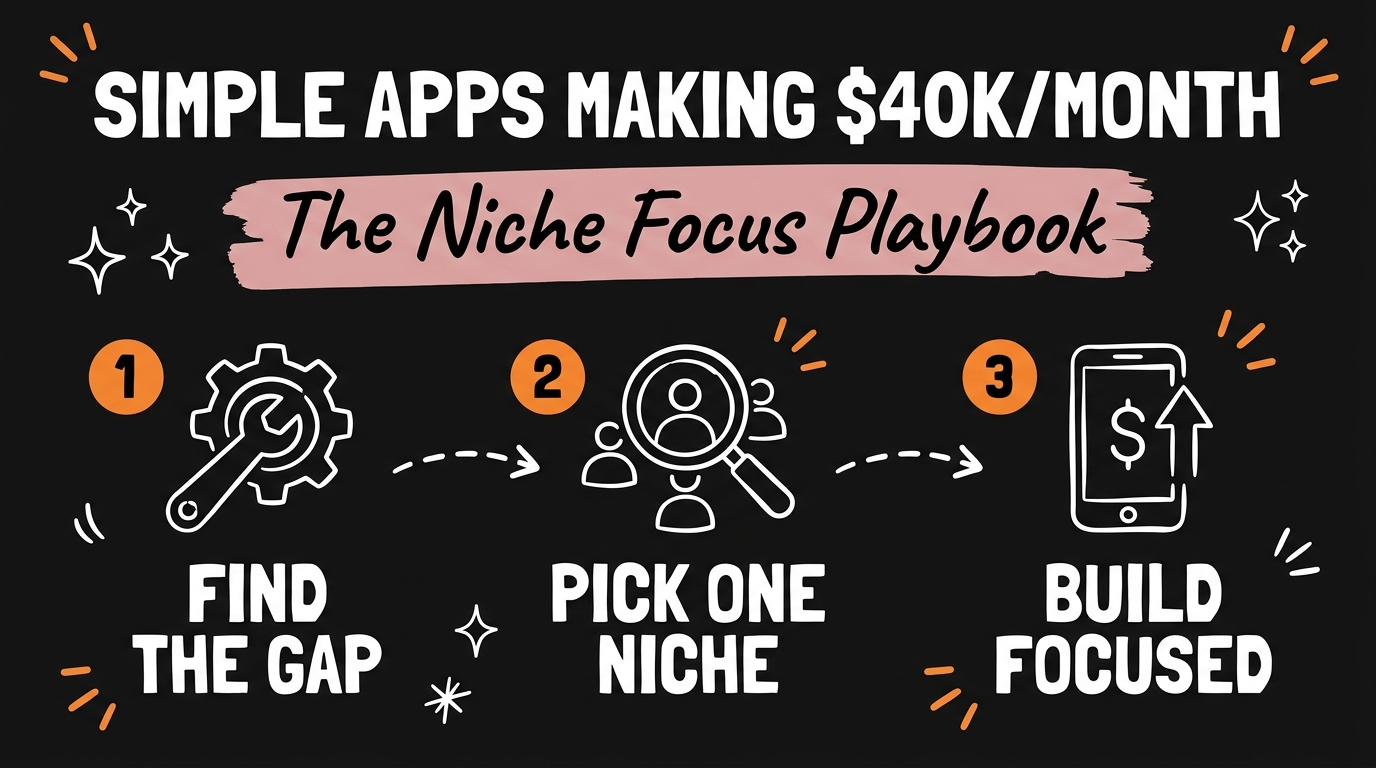
The simplest apps online are clearing $40,000 to $61,000 a month, and none of them are doing anything complex. They take a free tool people already use, find the one gap where it falls short, and build a focused version for a single specific audience. No new technology, no big team — just a tighter version of something that already works.
Get the Free Guide
Get the exact playbook for finding a free-tool gap, niching it to one audience, and shipping a focused app around it.
Get the free Niche App Playbook →
What Do the Apps Making $40K–$61K a Month Have in Common?
Every one of them follows the same three-step pattern: pick a free tool people already rely on, find the specific place it falls short for one community, and build a small, focused system around that gap. A basic translation app with Apple Watch support brings in $50,000 a month. A screen time blocker built around the Christian faith brings in $40,000 a month. A design subscription built only for churches clears $61,000 a month. None of these are technically hard. Apple’s own Translate app, generic screen-time tools, and general design subscriptions already exist — these apps just serve one audience better than the free, general-purpose version ever will.
This is the same reverse-engineering approach we walked through in how to clone a $1M App Store app with Claude Code: the winning apps aren’t the most feature-rich, they’re the most focused.
Why Out-Focusing Beats Out-Building
You don’t need to out-build Google, Apple, or Adobe — you need to out-focus them. A general translation app has to work for every language, every use case, every type of user. That breadth is exactly why it can’t serve any single group perfectly. A general screen-time blocker has to stay neutral for a global audience, so it will never speak directly to a Christian parent trying to protect a specific set of values. A general design tool has to serve freelancers, agencies, and enterprises all at once, so it can’t build templates specifically for a church bulletin or sermon slide deck.
That gap between “works for everyone” and “works perfectly for one group” is where the $40K–$61K/month apps live. The bigger the incumbent, the more gaps it leaves for a niche version to fill.
How to Find Your Own Niche App Idea in a Weekend
Finding this kind of gap doesn’t require months of research. Here’s the process, condensed:
- List five free tools you or people around you use daily — translation apps, habit trackers, screen-time blockers, budgeting apps, design tools.
- Pick one community you understand well — a faith group, a profession, a hobby, a life stage (new parents, retirees, students).
- Find the specific friction that community has with the general version of the tool. Ask them directly, or search Reddit and app store reviews for complaints from people in that group.
- Sketch the smallest version that removes that friction — often just a rebrand, a different default set, or one missing feature.
- Build the MVP with Claude Code and ship it to the App Store or as a simple web app within a week, not a quarter.
If you want a deeper walkthrough of turning an existing app into a validated idea with an ICP, pain point, and revenue model, screenshotting the App Store for a $1M app idea covers that process end to end.
Real Examples: Translation, Screen Time, and Design Apps
The table below breaks down the pattern behind each example from the video — the free tool being niched, the audience it’s built for, and the monthly revenue.
| Free Tool Being Niched | Target Audience | Reported Monthly Revenue |
|---|---|---|
| Translation apps (like Apple Translate) | Apple Watch users who need hands-free translation | $50,000 |
| Screen time blockers | Christian parents and families | $40,000 |
| Design subscription tools | Churches needing bulletins and sermon graphics | $61,000 |
Notice none of these are “AI apps” in the flashy sense — they’re narrow, boring, and built for one group. That’s the same insight behind how boring apps make $80K a month with Claude Code: the app category doesn’t need to be exciting for the revenue to be real.
FAQ
Do I need to be a developer to build a niche app like this?
No. As of July 2026, tools like Claude Code let you describe the app you want in plain language and generate a working build, which is why solopreneurs with no engineering background are shipping apps like these in days rather than months.
How do I find the “gap” in a free tool?
Read app store reviews and Reddit threads from people in your target community, and look for the same complaint repeated across dozens of posts — that repeated friction point is usually the gap a focused app can close.
Why do faith-based and hobby niches show up so often in these examples?
Tight-knit communities with a shared identity (a faith group, a profession, a hobby) are easier to reach through existing channels — church networks, subreddits, Facebook groups — and they’re more willing to pay for something built specifically for them instead of a generic alternative.
Is $40K–$61K a month realistic for a first app?
It’s realistic as a ceiling to aim for, not a guaranteed outcome — these are reported top performers, not the average. The reliable part of the pattern is the process: niche a free tool for one community and out-focus the incumbent.
What’s the fastest way to validate a niche app idea before building it?
Search for the free tool’s complaints from your target community first. If dozens of people in that group are already voicing the same frustration, you have a validated gap before writing a single line of code.
Ready to stop guessing and actually ship one of these? Join the Vibe Coding Build → for the full build walkthroughs and prompt systems used to turn ideas like these into working apps.