
How a Faceless Finance Channel Makes $58K/Month With AI
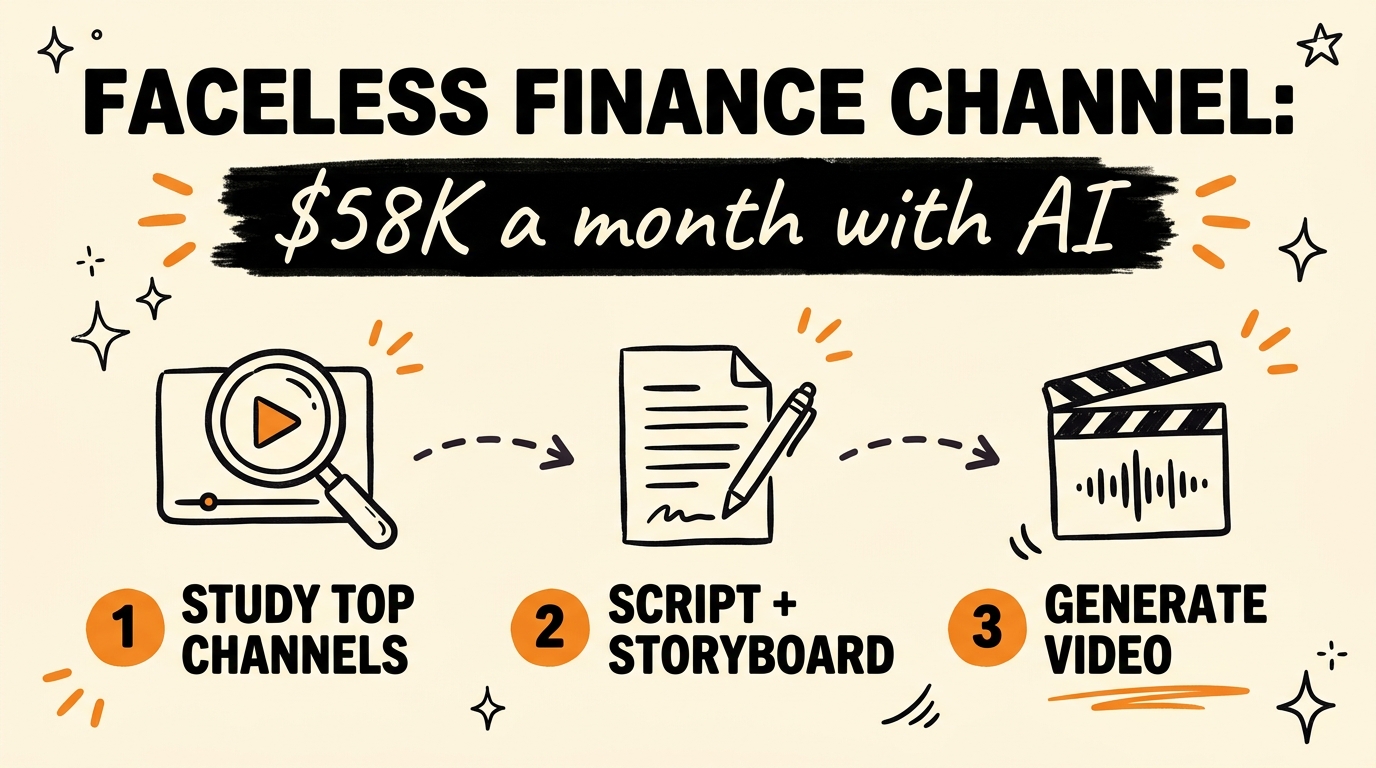
A faceless finance channel reportedly making over $58,000 a month does not ask AI to “make a YouTube video.” It runs a five-stage pipeline instead: AI studies channels already pulling millions of views, breaks their videos down into topics, titles, thumbnails and structure, and those patterns become the brief for the next video. Only then does Claude research the topic and write a documentary-style script, ChatGPT turn that script into a visual storyboard, and AI generate the visuals, voiceover and thumbnail.
The order is the whole trick. Research first, generation last.
Get the Free Guide
The full breakdown of the five-stage system: what AI looks for when it studies a competing channel, the prompts for the documentary script and the storyboard, and the fix table for when the output comes back generic.
Get the free Faceless Channel System →
Why does “make me a YouTube video” produce nothing watchable?
Because a prompt with no research in front of it has nothing to aim at. When you hand Claude or ChatGPT a bare topic, the model fills the gap with the average of everything it has read, which is exactly the bland, middle-of-the-road video nobody finishes. It has no idea which titles people in your niche actually click, which thumbnail style wins, or how long the opening needs to be before the payoff lands.
The faceless channels that work solve this by never generating from a blank slate. Every video starts from evidence pulled off channels that already have the views. The AI is not being asked to be creative. It is being asked to notice what is already working and then build to that shape.
What are the five stages of the system?
The pipeline has five stages, and each one hands a specific artifact to the next.
| Stage | What happens | What comes out |
|---|---|---|
| 1. Study | AI analyses channels already pulling millions of views | A list of what performs in the niche |
| 2. Break down | Topics, titles, thumbnails and video structure get separated | Reusable patterns, not copied videos |
| 3. Script | Claude researches the topic and writes a documentary-style script | A narrated script with a real arc |
| 4. Storyboard | ChatGPT turns the script into a visual storyboard | A shot list tied to the narration |
| 5. Generate | AI produces the visuals, voiceover and thumbnail | The finished video, no face on camera |
Notice that stages 1 and 2 produce no video at all. That is normal. Those two stages are what make stages 3 through 5 worth running, and skipping them is the single most common reason a faceless channel stalls at a few hundred views a video.
If you want a closer look at just the analysis half, I broke it out separately in how to reverse-engineer viral videos with AI.
How do you make the research stage actually specific?
The research stage works when you force the AI to separate the elements instead of giving you one blended opinion. Ask for a breakdown of a top video in four named buckets and you get something usable:
- Topic: what question or claim the video is built on, in one sentence.
- Title: the exact wording, plus what the title promises and what it withholds.
- Thumbnail: the subject, the text on it, the colour contrast, the emotion.
- Structure: the hook, the beats in the middle, where the payoff sits, how it closes.
Run that across five or six videos from the same niche and the pattern shows up on its own. Repeated title shapes. The same three or four topic angles. A thumbnail formula the whole niche has converged on. That pattern, not any single video, is what the next script gets built from.
For the finance niche specifically, this is where a research agent earns its keep, because the facts have to be right before the script goes anywhere. I covered that setup in Claude finance agents for stock research.
Why documentary style instead of a talking-head script?
Documentary style is the format that works without a presenter. There is no face to carry the energy, so the structure has to do it: a narrator, a question posed early, information that arrives in an order, and a conclusion that pays off the opening. That is also the format AI writes well, because it is mostly narration over visuals rather than personality and timing.
It also explains why the storyboard stage exists. A documentary script is a voiceover track, and a voiceover track with no shot list is just audio. ChatGPT converting the script into a storyboard is the step that decides what appears on screen for each line, which is what keeps the generated visuals from drifting into a slideshow of unrelated images.
Can you run this in a niche that isn’t finance?
Yes, and that is the point of building it as a system rather than a channel. Nothing in the five stages is finance-specific. The study stage reads whatever niche you point it at, the breakdown stage looks for the same four elements, and the script and storyboard stages do not care what the subject is. Swap the channels you analyse in stage 1 and the pipeline runs on history, health, tech, true crime or anything else with an audience.
As a solopreneur or agency owner, that is the version worth setting up: one pipeline, several niches, no face in any of them. If you want the pipeline to live inside a reusable agent instead of a folder of prompts, the Claude YouTube agent skill is the pattern I use for that.
FAQ
How much does a faceless finance channel actually make?
The channel in this breakdown is reported to make over $58,000 a month. That figure is the reported number for one channel, not a typical result, and faceless channel earnings vary enormously with niche, ad rates and how long the channel has been running.
Do I need both Claude and ChatGPT for this?
The system as described uses Claude for the research and the documentary script, and ChatGPT for turning that script into a visual storyboard. You can run both stages in one model, but splitting them keeps each prompt focused on a single job, which is why the original pipeline divides them.
What does AI look for when it studies a competing channel?
Four things: the topic the video is built on, the exact title wording, the thumbnail composition, and the structure of the video from hook to payoff. Those four separated out across several videos are what produce a pattern you can build on.
Is a faceless channel against YouTube’s rules?
Not on its own. Faceless channels are allowed, and so is AI-assisted production. What matters is that the content is original and adds value rather than being reuploaded or mass-produced with no input, which is what YouTube’s inauthentic content policy targets. As of October 2026, YouTube also requires disclosure of realistic synthetic content.
How long does one video take with this system?
Most of the time goes into stages 1 and 2, and that work is reusable. Once the pattern for a niche exists, you are running the script, storyboard and generation stages per video rather than redoing the research each time.
The part worth copying
The money in that channel is not in the AI tools, because everyone has the same tools. It is in the order of operations: study what already works, break it into patterns, then generate against those patterns instead of against a blank prompt. A faceless channel built that way can run in any niche, by one person, with no camera.
Grab the free Faceless Channel System guide for the prompts and the setup. And if you want to build the whole pipeline out properly with the rest of the systems I run, Join the Vibe Coding Build →