
Build a Live App in Hours With Claude Code and Railway
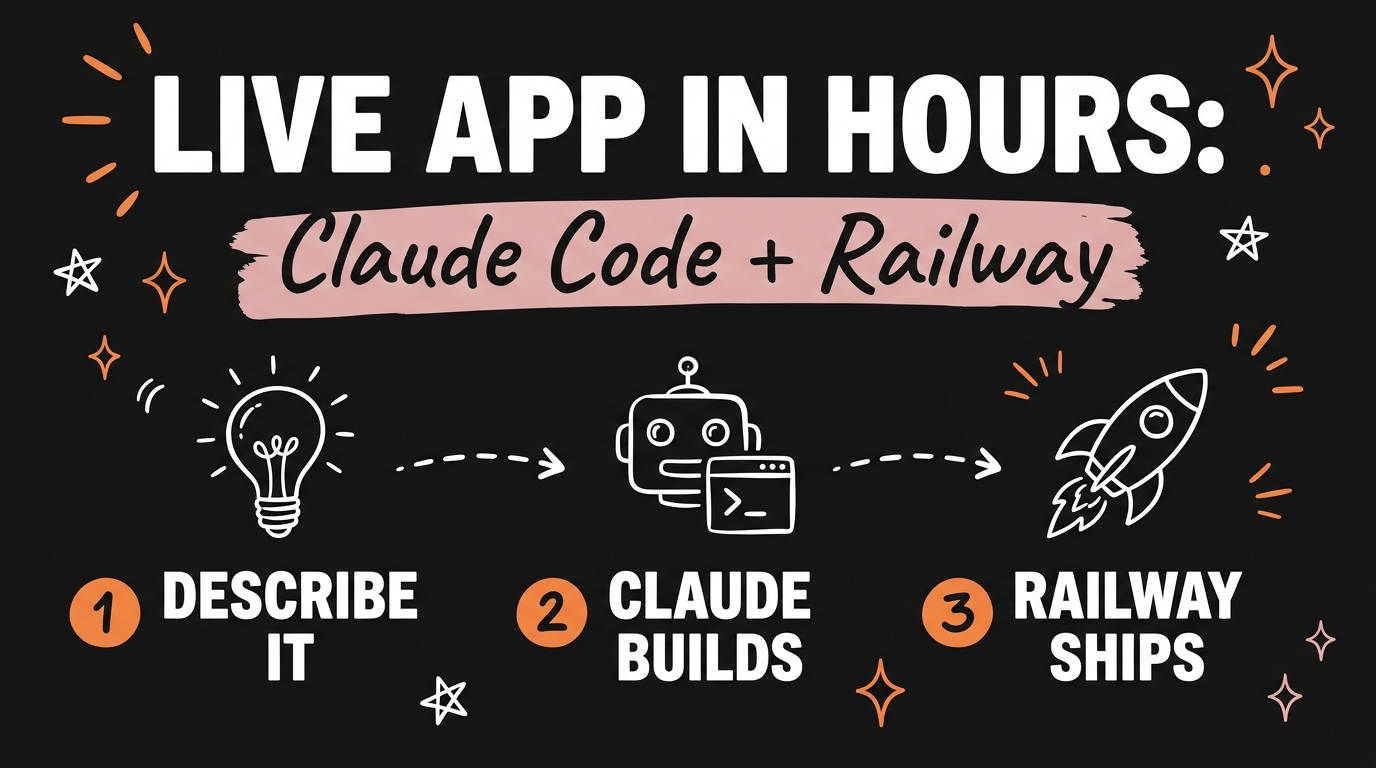
You can build a live, working app in hours — not months — using exactly two tools: Claude Code (Anthropic’s AI coding agent) builds the entire app from a plain-English description, and Railway hosts it, runs the database, and deploys it to the web. No dev team, no thousands of dollars, no code written by you. As of July 2026, this two-tool stack is the fastest route from “I have an idea” to “here’s my live URL” for people who have never opened a code editor.
Get the Free Guide
The guide walks you through the full zero-code launch playbook — the exact prompts, the Railway setup, and the debug loop that gets your first app live.
Get the free Zero-Code App Launch Playbook →
Why Does Everyone Still Think Apps Take Months to Build?
Most people overestimate app-building because they’re picturing the old process: hire developers, write a spec, wait through sprints, pay invoices. That process really did take months and thousands of dollars — and it’s exactly the layer that AI coding agents have now removed. Claude Code doesn’t help you write code faster; it writes the code for you while you direct it like a founder.
The mental shift matters more than the tools. When the technical layer disappears, the only things left between you and a live app are (1) a clear description of what you want and (2) a place to host it. That’s the whole stack: Claude Code for the first, Railway for the second.
If you’re brand new to the agent side of this, start with Claude Code for non-developers — it covers Plan Mode and how to talk to the agent when you can’t read the code it writes.
What Does Each Tool Do in the Stack?
The stack has exactly two layers: Claude Code is the builder, and Railway is the infrastructure. Here’s the split:
| Job | Tool | What it replaces |
|---|---|---|
| Turning your description into working code | Claude Code | A development team |
| Hosting the app on the web | Railway | Server setup and DevOps |
| Running the database | Railway (Postgres in one click) | A database administrator |
| Deploying updates | Railway (auto-deploys from GitHub) | A release engineer |
| User login and accounts | Claude Code builds it into the app | An auth specialist |
| Fixing errors | You paste the error back into Claude Code | A debugging session you’d pay for |
Notice who isn’t in the table: you, writing code. Your job is describing, deciding, and testing — the founder work. Everything below that line is handled by the agent or the platform.
How Does Railway Get Your App Live?
Railway takes the app Claude Code built and puts it on the internet with a real URL, a running database, and automatic redeploys — usually in a few minutes. You connect your GitHub repository (Claude Code can create and push to it for you), Railway detects what kind of app it is, builds it, and gives you a public link. When you push a change, Railway redeploys automatically.
This is the piece most no-code tutorials skip. An app on your laptop isn’t a product; an app with a URL is. Railway also provisions a Postgres database in one click and hands your app the connection details as environment variables — which matters because Claude Code knows how to wire those up when you simply tell it, “connect this to my Railway Postgres database.”
What’s the Idea-to-Live-App Workflow?
The full workflow is five steps, and the first one is the only one that takes real thought:
- Describe the app. Write out what the app does, who uses it, and what screens it needs. This becomes your build prompt — the CLAUDE.md master prompt method is the strongest way to structure it.
- Let Claude Code build. Open Claude Code, paste the description, and let it plan and generate the app — pages, database schema, login, all of it.
- Test and iterate. Run the app locally, click through it, and tell Claude Code what to change in plain English. Errors get pasted straight back to the agent; it fixes its own mistakes.
- Push to GitHub and connect Railway. Ask Claude Code to create the repo and push. In Railway, create a project from that repo and add a Postgres database.
- Deploy and share the URL. Railway builds and deploys. You now have a live app — typically the same day you had the idea.
Steps 2 through 5 are mostly waiting and clicking. The quality of your app is decided in step 1, which is why the free playbook above spends most of its pages on the description prompt.
Why Does Removing the Technical Layer Change the Money Math?
The point isn’t saving time — it’s that the technical layer was the barrier between you and a profitable product. When building costs months and thousands of dollars, only well-funded ideas get built. When building costs hours and roughly $5–$20 a month in Railway hosting, you can afford to ship small, niche, “boring” apps and let the market tell you which one works.
That’s the model behind the solo builders clearing serious revenue with tiny tools — simple niche apps are making $40K to $61K a month by serving one specific audience well. You don’t need a venture-scale idea. You need one underserved group and a stack that lets you ship to them this week.
FAQ
Can I build an app with Claude Code without knowing how to code?
Yes. You describe the app in plain English and Claude Code writes every file itself. Your job is to direct, test, and paste any errors back to the agent so it can fix them.
What does Railway actually do in this stack?
Railway hosts the app on a public URL, provisions the Postgres database, stores your environment variables, and automatically redeploys every time you push an update to GitHub.
How long does it take to go from idea to live app?
A simple app — a tracker, a client portal, a niche tool — typically goes from description to live Railway URL in a few hours. Complex apps take longer, but days, not months.
How much does it cost to build and host an app this way?
As of July 2026 you need a Claude subscription for Claude Code, and Railway hosting starts at around $5 a month for a small app with a database — versus thousands of dollars for a traditional development team.
What kinds of apps can I build with Claude Code and Railway?
Anything web-based: dashboards, booking tools, trackers, client portals, membership sites, and small SaaS products. Apps with user accounts and databases are fully within reach because Claude Code builds the auth and Railway runs the database.
Ship Your First App This Week
The excuse era is over: Claude Code removes the dev team, Railway removes the infrastructure, and what’s left is your idea and a few focused hours. Write the description, let the agent build, deploy to Railway, and put a real URL in front of real users.
If you want to build this alongside people doing the same thing — with the prompts, systems, and feedback to go from first app to first paying user — Join the Vibe Coding Build →