
Grow a Niche Service Account to 100K With AI Research
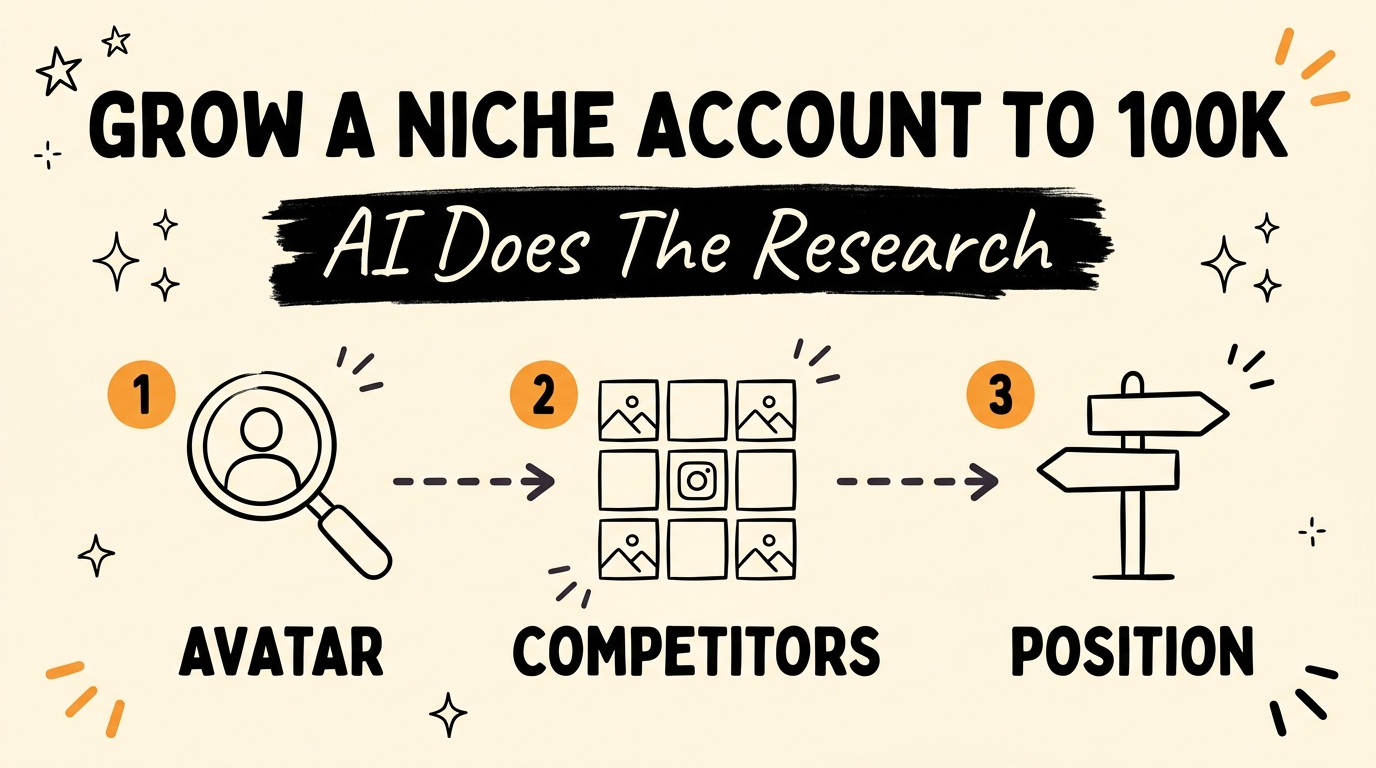
Growing a niche service account from zero to 100K followers comes down to three moves: know the customer avatar cold, pull proven topic buckets from competitors who already win with that audience, and build a positioning angle that owns a specific lane. Claude Code can run the research for all three in minutes instead of days.
Get the Free Guide
Grab the full playbook with the exact Claude Code prompts for avatar research, competitor analysis, and positioning.
Get the free Niche Account Growth Playbook →
Most niche accounts stall because they skip straight to posting without doing the homework a real agency would do for a client. Before a single piece of content goes out, you need to know who you’re talking to, what’s already working in that space, and what makes your angle different. Here’s how to run that research with Claude Code instead of guessing.
What Does It Mean to “Study the Customer Avatar”?
Studying the customer avatar means answering a short list of concrete questions about the exact person the account serves, not a vague demographic description. What do they buy, how old are they, and what objections stop them from buying?
Run a niche interviewer prompt in Claude Code that walks through six focused questions about the audience: buying behavior, age range, income level, biggest objection, where they already spend time online, and the language they use to describe their own problem. The output is a working profile you can hold up against every piece of content before you publish it. If a post doesn’t speak to that profile, it doesn’t go out.
How Do You Build a Competitor List That Actually Helps?
Building a useful competitor list means finding accounts already winning with your exact audience on Instagram, then studying only their top-performing posts instead of their entire feed. Scrolling a competitor’s whole grid wastes time on the posts that flopped along with the ones that worked.
A Claude Code researcher prompt automates this step:
- Pull a list of accounts serving the same niche and audience.
- Filter each account down to its top posts by engagement, not just recent posts.
- Extract the topic buckets and formats those top posts share (carousel, talking-head, meme, before/after).
That list becomes your content calendar’s starting point. You’re not copying the posts, you’re copying the categories that already proved they resonate with this specific audience. If you’re building this for a client rather than your own account, the same research feeds directly into getting local business clients with AI.
What Makes a Positioning Angle Work?
A positioning angle works when it carves out a distinct lane the competitor list isn’t already covering, whether that’s a narrower topic focus, a different content format, or a more specific avatar than everyone else is targeting.
| Positioning lever | Example |
|---|---|
| Topic selection | Everyone covers “social media growth,” you only cover “growth for local service businesses” |
| Format | Everyone posts talking-head clips, you post screen-recorded workflows |
| Avatar specificity | Everyone targets “creators,” you target “solo agency owners under 10K followers” |
Pick one lever and push it further than the accounts on your competitor list. A narrow, well-defended lane beats a broad, crowded one every time you’re starting from zero. A weak positioning angle usually traces back to generic messaging, which is the exact problem the brand clarity prompt is built to fix.
Once the account is live, your engagement rate becomes the real content playbook, telling you which topic buckets from your competitor research are actually landing with your avatar.
For the full set of prompts, including the exact avatar interview and competitor research templates, grab the free playbook.
FAQ
How long does the avatar research step take with Claude Code?
Running the six-question interviewer prompt and reviewing the output typically takes 10 to 15 minutes, compared to hours of manual customer research.
Do I need coding experience to run these prompts?
No. The prompts run directly in Claude Code as plain-language instructions. You paste in the prompt, answer a couple of clarifying questions if asked, and read the output.
How many competitor accounts should I study?
Five to ten accounts already serving your niche audience is enough to spot repeating topic buckets and formats without drowning in data.
What if my niche doesn’t have obvious direct competitors?
Look one level out. If you serve local service businesses, study accounts serving adjacent audiences (freelancers, agency owners) and adapt the formats that transfer.
Should I change my positioning angle if it’s not growing fast?
Give a positioning angle at least 30 days and a consistent posting schedule before judging it. If it’s still flat after that, revisit the competitor list for a lane that’s less crowded.
If you want to build a full content system around this research instead of running it one post at a time, that’s exactly what we cover inside Vibe Coding Mastery.