
4 Free GitHub Alternatives to Apps You Pay For
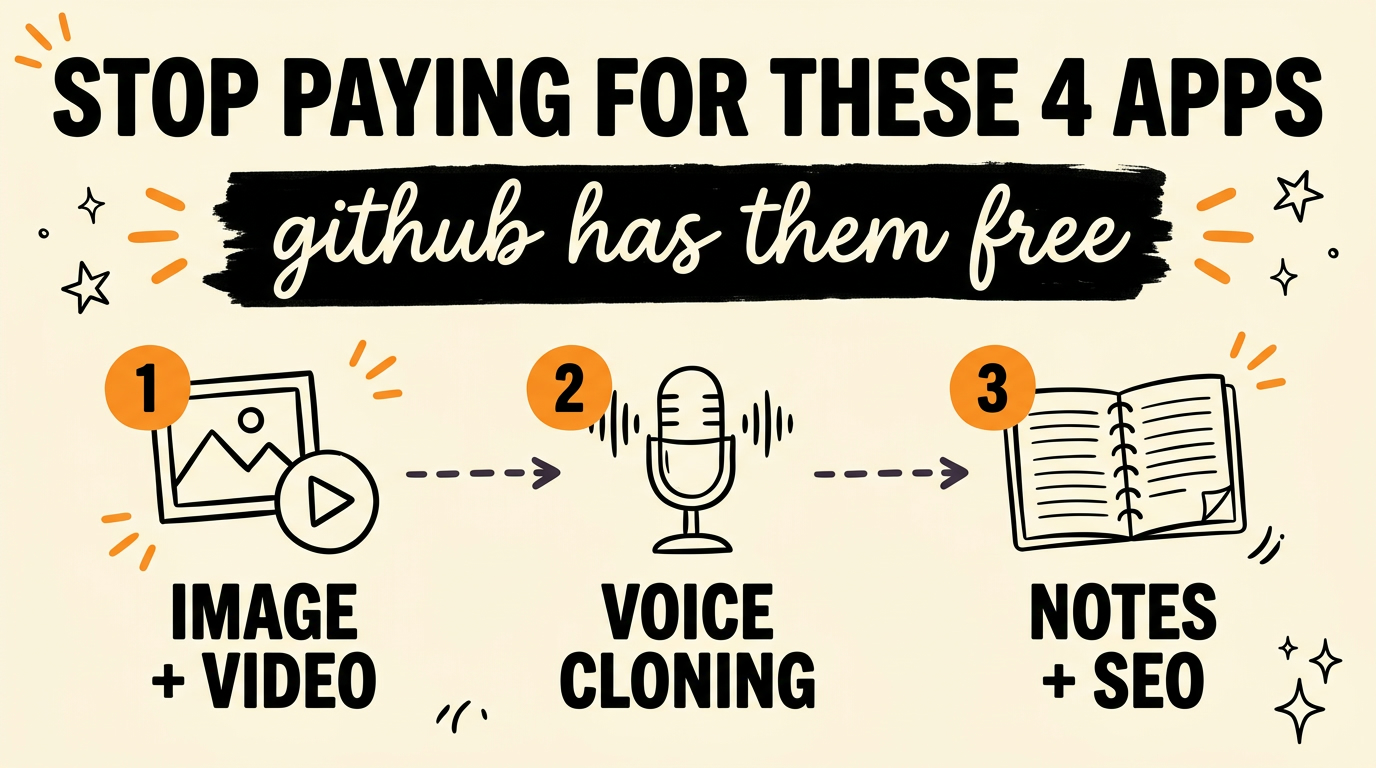
GitHub has a free, open source version of most paid creative software, and four of them are good enough to cancel a subscription over. Open Generative AI puts 400+ image, video and lip sync models behind one interface instead of a Higgsfield or Midjourney plan. Voice Studio clones voices entirely on your own machine instead of ElevenLabs. Open SEO does rank tracking, backlinks and site audits on a pay as you go API key instead of a Semrush seat. AppFlowy runs docs and databases like Notion with the files sitting on your own disk. All four are listed below with their license and their real install commands, verified as of November 2026.
Get the Free Guide
The free guide has all four repo URLs, the install commands for every operating system, which API key each tool needs and where to put it, and the Claude Code prompts I use to set them up without reading a single README. It also includes five bonus repos that are not in the video: OpenWhispr for voice dictation, OpenProject for project management, Cal.diy for scheduling, Chatwoot for customer support and Cap for screen recording.
Get the free Open Source Swap Stack guide →
What Are the Four Free GitHub Alternatives?
Each of these four repos targets one specific paid product and matches the part of it most people actually use. Here is the whole set, with the license and what it needs before it will run.
| Paid tool | Free alternative | License | What it needs to run |
|---|---|---|---|
| Higgsfield, Midjourney, Runway | Open Generative AI | MIT | Node.js v18+ and a Muapi.ai access key, or the hosted version |
| ElevenLabs | Voice Studio | AGPL-3.0 | Your own machine, no account |
| Semrush, Ahrefs | Open SEO | MIT | A DataForSEO API key, plus Docker or Cloudflare to host it |
| Notion | AppFlowy | AGPLv3 | A desktop download, optional self-hosted server |
Can Open Generative AI Match a Paid Image and Video Tool?
Open Generative AI is a self-hosted creative studio that routes to 400+ generation models through the Muapi.ai gateway, so one interface covers the jobs that normally need three subscriptions. The repo breaks the catalogue down as 70+ text-to-image models including Flux, Nano Banana, SDXL and Midjourney, 70+ image-to-image models that accept up to 14 reference images at once, 85+ text-to-video models including Kling, Sora, Veo, Wan and Seedance, 120+ image-to-video models, and 9 lip sync models across portrait and video modes.
It is MIT licensed, so commercial use is fine. Three ways to run it:
- Hosted, free and with no setup, at
https://muapi.ai/open-generative-ai. - Desktop app, a one-click installer for macOS, Windows or Linux that bundles
sd.cppfor local inference. - Self-hosted, as a Next.js web app you clone and run yourself.
The self-hosted route is three commands:
1
2
3
git clone --recurse-submodules https://github.com/Anil-matcha/Open-Generative-AI.git
cd Open-Generative-AI
npm run setup
Then npm run electron:dev for the desktop build, or npm run dev for the web version at http://localhost:3000. The --recurse-submodules flag is the one people skip, and the setup fails without it. Your Muapi.ai access key is entered on first use and stored in browser localStorage, so there is no .env file to manage.
How Do You Clone a Voice Without ElevenLabs?
Voice Studio is a fully local voice tool that does cloning, voice design, dubbing, dictation and transcription on your own hardware, with no account and no per-character billing. The project describes itself as the open source, fully local ElevenLabs alternative and covers 646 languages. Voice design means you describe a voice in words and it generates one.
Install is one line per platform:
1
2
3
4
5
6
7
8
9
10
# macOS, Homebrew
brew tap debpalash/tap
brew trust --cask debpalash/tap/voicestudio
brew install --cask debpalash/tap/voicestudio

# macOS or Linux, universal installer
curl -fsSL https://voicestudio.sh/install | sh

# Windows, PowerShell
irm https://voicestudio.sh/install.ps1 | iex
Models download through the app’s own Model Manager, which asks before it pulls anything and shows the license for each model. That matters, because the app is AGPL-3.0 but the model weights and the audio you generate carry their own separate licenses. If you have tried Microsoft VibeVoice for free voice cloning, this is the same idea with a full interface wrapped around it.
What Replaces Semrush and Notion?
Open SEO covers the Semrush feature list on a bring your own key model, and AppFlowy covers Notion with local files, so the two together handle research and writing without a subscription on either side.
Open SEO is MIT licensed and does keyword research, rank tracking, competitor insights, backlink analysis, site audits and AI visibility monitoring. Instead of a monthly plan it runs on your own DataForSEO API key, so you pay per query. Setup docs live in the repo: docs/DATAFORSEO_API_KEY.md for the key, docs/SELF_HOSTING_DOCKER.md for a server, docs/SELF_HOSTING_CLOUDFLARE.md for Cloudflare, and docs/LOCAL_DEVELOPMENT.md for running it on your laptop. Config goes in a .env file copied from .env.example. The part worth the setup time is the Model Context Protocol support, which lets Claude, ChatGPT or Cursor query your SEO data directly, the same pattern as the free Claude SEO skill for AI search ranking.
AppFlowy is an AGPLv3 workspace built with Flutter and Rust, covering documents, databases, Kanban boards, team wikis and an Ask AI feature for summarising and drafting. Desktop builds for macOS, Windows and Linux come from the GitHub releases page, with FlatHub, Snapcraft and Sourceforge as alternative channels, plus native apps on the App Store and Play Store for Android 10+. There is a step by step self-hosting guide if you want the server side on your own infrastructure too, and the project documents a local AI setup through Ollama, so the AI features can run against a model on your machine rather than someone else’s.
What Does It Cost to Run All Four?
Two of the four cost nothing to run and two are metered, which is a different cost shape from four monthly plans. Voice Studio and AppFlowy run on your own hardware with no key and no account. Open Generative AI needs a Muapi.ai access key or the free hosted version, and Open SEO needs a DataForSEO key billed per query.
The order I would install them in:
- AppFlowy first, because it is a download and you can move your notes across the same afternoon.
- Voice Studio second, because it needs no key and the only wait is the model download.
- Open Generative AI third, starting on the hosted version to see whether the models are good enough before you install anything.
- Open SEO last, because it is the only one with a real hosting decision to make.
If you are stacking free tools, free LLM APIs for Claude Code is the other half of this, and it removes the usage-limit problem the same way.
FAQ
Are these GitHub alternatives really free?
The software is free and open source in all four cases. Open Generative AI and Open SEO call paid APIs, so you pay the API provider directly for usage instead of paying a monthly subscription, and Voice Studio and AppFlowy cost nothing to run at all.
Can I use these open source tools commercially?
Open Generative AI and Open SEO are MIT licensed, which permits commercial use with almost no conditions. Voice Studio is AGPL-3.0 and AppFlowy is AGPLv3, which allow commercial use under their terms, and for Voice Studio the model weights and generated audio carry separate licenses you should check.
Do I need to know how to code to install them?
AppFlowy and Voice Studio are installers, so no. Open Generative AI and Open SEO involve a terminal, and this is exactly the kind of job to hand to an AI coding agent: point Claude Code at the repo URL and ask it to clone, install and start the thing.
Does Voice Studio actually run offline?
Yes. It runs entirely on your own device once the models are downloaded, which is the main difference from ElevenLabs. The Model Manager handles the downloads and asks before pulling anything.
Which paid app is easiest to cancel first?
Notion, because AppFlowy imports documents and databases and is a straight download with no key, so you can test it against your real notes in one sitting.
The Point
Four repos, four subscriptions gone, and the only ongoing cost is metered API usage on two of them. Start with the one you pay the most for each month and test it against your real work for a week before you cancel anything.
If you would rather the videos and the posts get made for you, that is what I built next. Paste any link or idea into Content Engine and get a published video in under 3 minutes, with DM automation armed to capture leads. Meet Content Engine →