
Copy a Viral Reel the Right Way: Structure First
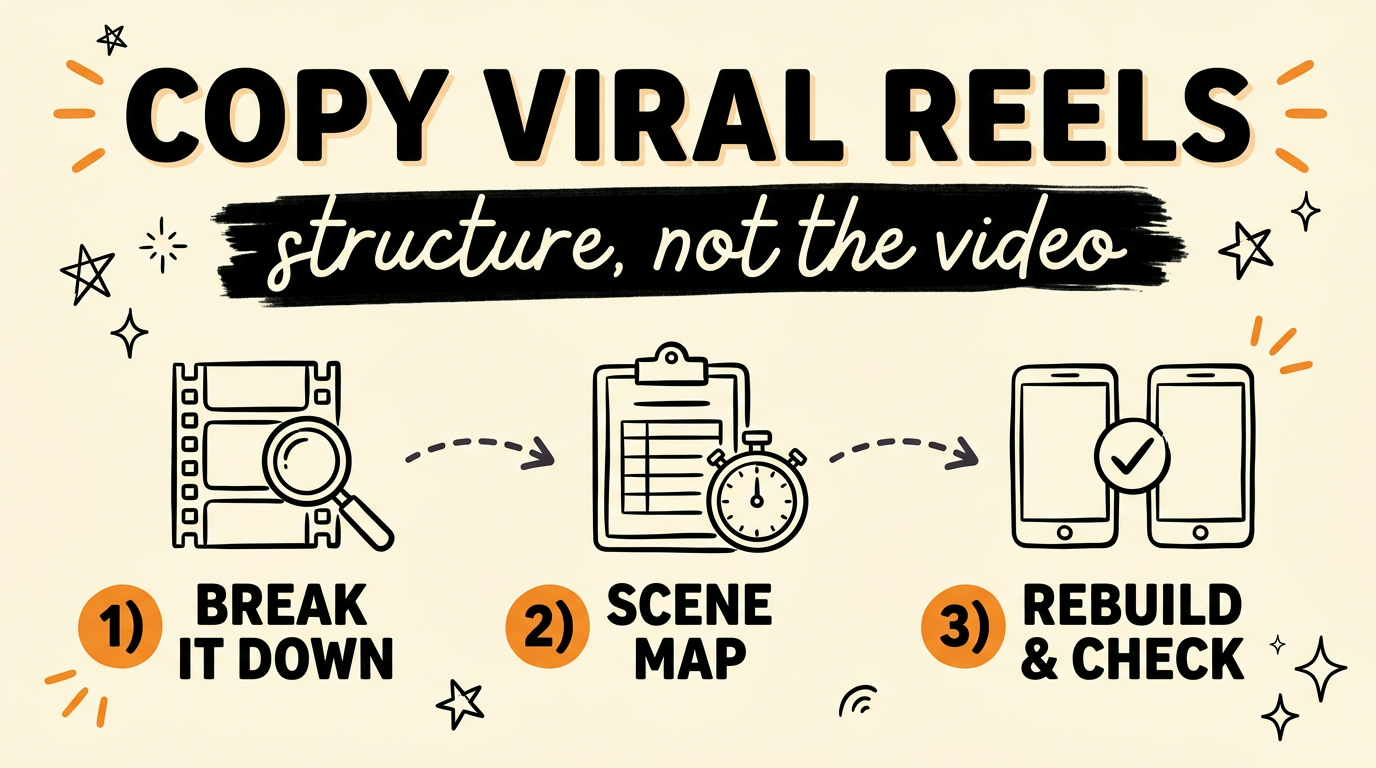
When you copy a viral reel, copy its structure and leave the video alone. The structure is the hook timing, the cut rhythm and the caption placement, and that is what held attention in the first place. The topic and the footage are the parts you replace with your own, which is why a shot for shot remake of someone else’s reel usually dies in the feed while the same skeleton with your material keeps working.
Get the Free Guide
The guide walks through the reel breakdown step: the install, the one command that pulls frames, cuts and a timestamped transcript off a video on your own machine, and the fix for every error it can throw.
Get the free Reel Breakdown Playbook →
Why Does Copying a Viral Reel Usually Flop?
Most copies fail because the creator copies the visible layer and throws away the mechanics. They match the footage, the sound and the on-screen look, then wonder why the watch time collapses. The reason is that none of those things are what kept people past second three. Timing did. The reel cut when attention was about to drift, the hook landed in under two seconds, the caption sat where the eye already was.
Here is the split that decides whether a remake works:
| Part of the reel | Copy it? | Why |
|---|---|---|
| Hook timing and the words it opens on | Yes | It is the reason anyone stayed past second three |
| Cut rhythm and how many times the picture changes | Yes | Pacing is a format choice, not content |
| Caption placement and treatment | Yes | A readable layout is reusable |
| The topic and the claims | No | Those are theirs, and their numbers are unverified |
| Footage, voiceover, music, logos | No | That is their material |
| The creator’s name or brand | No | It never belongs in your version |
Every line in the “yes” column is a number or a position. That is the useful part, because numbers and positions are things you can measure off a video and then reuse on a different subject.
How Do You Break a Reel Down Before Rebuilding It?
Run the reel through a breakdown before writing a single line of your own script. As of November 2026 I do this with a local Claude Code skill that wraps ffmpeg and a whisper.cpp model, and one command turns the video into evidence I can read. Nothing is uploaded, which matters when the file is somebody else’s reel sitting on your laptop.
The breakdown produces five things:
- One frame per second, stitched into contact sheets of 18 frames each, so an entire 45 second reel is two images you can scan in a glance.
- The first three seconds at 10 frames per second in a single sheet, because the hook is where the whole video is won and one frame per second is too coarse to see it.
- A list of cut times, pulled by scene detection, so the cut rhythm stops being a feeling and becomes a column of numbers.
- A transcript with word level timestamps, which gives you words per minute and the exact second the promise lands.
- A metadata file with duration, aspect ratio, frame rate and the spoken word count.
Reading that takes about five minutes and it is the difference between “this reel feels fast” and “this reel cuts every 1.8 seconds and the hook ends at 2.3”. The second version is something you can rebuild against.
What Goes in a Scene Map?
A scene map is a short table that turns the breakdown into a build plan, one row per beat of the original. For each row I write the time range, what is on screen, what the voiceover is doing, and what that beat is for. The last column is the one that transfers, because “name the mistake” or “show the proof” works on any topic while “a laptop on a desk” does not.
Underneath the table I keep three short lists:
- Visual grammar to keep: background, palette, text treatment, camera habits.
- Audio and pacing: words per minute, where the hook ends, how often the picture changes.
- Claims I have not verified: every number the original shows on screen.
That last list exists for one reason. Copying structure is fair game, and repeating a stranger’s made-up statistic is how you end up defending a number you never checked. The same discipline shows up in reverse engineering viral videos with AI and in the AI marketing studio method for recreating a viral video: study the mechanics, keep the mechanics, bring your own substance.
Why Check Your Version Against the Original Before Publishing?
Because pacing drifts while you write, and you are the last person who can see it. Once your own topic is on the skeleton, the hook tends to grow a sentence, the first cut slides a second later, and the thing that made the format work quietly disappears. A check pass puts your cut next to the original and compares the structure before anything goes live, which catches a buried hook while fixing it still costs nothing.
My check is a script that renders stills from my version and reports whether the build is stable, then I hold those stills against the original’s contact sheets. If the hook sheet looks slower than theirs, the hook is too long. That loop is how I have made close to a hundred reels, and it is the part people skip. For the full install and the commands, grab the free guide.
FAQ
Is copying a viral reel’s structure legal?
Keeping a format is normal practice, and formats are not what copyright protects. You replace the footage, the voiceover, the music, the on-screen claims and anything carrying the creator’s name or brand, and what you keep is timing and layout.
What do I actually measure in a reel breakdown?
Hook length, cut times, words per minute, caption position and the order the ideas land in. Those five numbers describe the format well enough to rebuild it on a new topic.
Do I need video editing software to do this?
No. The breakdown step is one command that calls ffmpeg and a local whisper.cpp model, and it writes images, a cut list and a transcript to a folder. You read the folder.
Does the reel leave my computer?
No. Frame extraction, scene detection and transcription all run locally, so the file and everything derived from it stay on your machine.
How long does a breakdown take?
The command runs in well under a minute on a 45 second reel, as of November 2026. Reading the sheets and writing the scene map is the slow part, and that is about five minutes.
Start With the Skeleton
Copying a viral reel works when you treat the video as evidence of a format instead of a thing to reproduce. Break it into frames, cuts, captions and hook timing, write the scene map, put your own topic on that skeleton, then check your version against the original before you publish. The format carries over. The content is yours.
If you want this running across your whole pipeline, paste any link or idea and get a published video in under 3 minutes, with DM automation armed to capture leads. Meet Content Engine →