
Claude Fable 5.1: The AI Model That Gets Cheaper at Scale
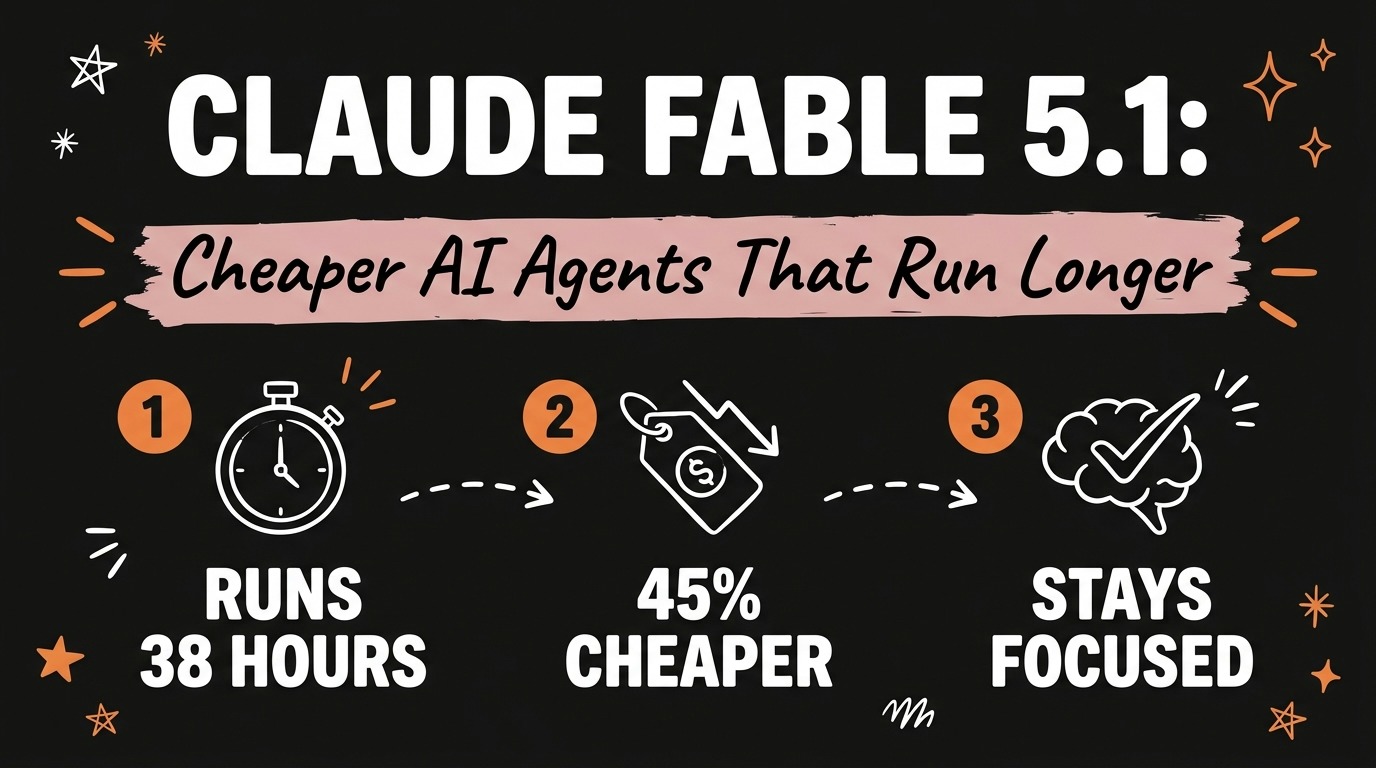
Most AI models get sloppier the longer a task runs. Claude Fable 5.1, released by Anthropic in September 2026, does the opposite: it costs up to 45% less on agentic tasks than its predecessor and stayed on-task through a 38-hour unattended run. For anyone running automations or agents in their business, that combination of lower cost and longer focus is the part worth paying attention to.
Get the Free Guide
Get the setup steps, the actual commands, and a fix table for running long, unattended Claude Code sessions the way Fable 5.1 is built to handle them.
Get the free Claude Fable 5.1 Workflow Breakdown →
What Is Claude Fable 5.1?
Claude Fable 5.1 is Anthropic’s general-availability model released alongside Claude Mythos 5.1 in September 2026. The two are functionally identical, but Mythos 5.1 is gated to vetted cybersecurity professionals and life sciences researchers through Anthropic’s trusted access programs, while Fable 5.1 is open to everyone. Standard pricing stayed at $10 per million input tokens and $50 per million output tokens, the same as Fable 5, but the model got faster and cheaper to actually run because of how it handles cache.
How Much Cheaper Is Claude Fable 5.1 to Run?
Claude Fable 5.1 cuts cache read costs by 75%, down to $0.25 per million tokens, which is the main driver behind the overall savings. For typical workloads that works out to roughly 25% lower cost than Fable 5. For agentic workloads specifically, where the model is repeatedly reading back its own context and tool results, the savings climb to around 45% because agentic work leans so heavily on cached tokens.
Anthropic also published benchmark gains alongside the pricing change:
| Benchmark | Fable 5.1 | Fable 5 | Change |
|---|---|---|---|
| Terminal-Bench-Science 0.1 (agentic research) | 52.6% | 24.7% | +28.0 pts |
| Terminal-Bench 4.0 (agentic coding) | 55.8% | 42.0% | +13.8 pts |
| OSWorld 2.0 (strict) | 41.7% | 36.1% | +5.6 pts |
| CursorBench 3.2.0 (coding) | 73.4% | 70.5% | +2.9 pts |
| Humanity’s Last Exam (with tools) | 65.0% | 63.8% | +1.2 pts |
The biggest jump is on the two agentic benchmarks, Terminal-Bench-Science and Terminal-Bench 4.0, which measure how well a model handles multi-step, tool-using work rather than a single question-and-answer exchange. That lines up with where the cost savings are biggest too: the model got both cheaper and better at exactly the kind of long, autonomous task that used to get expensive and unreliable at the same time.
What Can Claude Fable 5.1 Do Over Long, Unattended Runs?
Claude Fable 5.1 is built to hold focus across extended, unattended sessions instead of drifting or losing the thread as the task gets longer. Anthropic’s case study came from a machine learning engineer at Ramp who set the model loose on a research problem and let it run for 38 hours straight. Over that stretch, it:
- Diagnosed that an earlier result was a label artifact, not a real finding.
- Corrected the underlying issue on its own.
- Launched six parallel experiments overnight to test the fix.
- Came back with results and a recommended next step, no check-ins required.
That kind of run only works if a model can keep internal record-keeping straight and reprioritize its own task list without a human nudging it back on track. Fable 5.1 also improved on end-to-end workflow mapping across multiple codebases and services, which matters if your automations touch more than one tool or repo at a time.
How Do Agency Owners and Solopreneurs Use This?
For anyone running a one-person agency or a lean automation stack, the practical shift is that you can hand off a genuinely hard, multi-hour task and trust the model to stay on it instead of babysitting every step. That’s the same instinct behind beating context rot in long Claude Code sessions: the longer an agent runs, the more it needs to manage its own memory and priorities well, and Fable 5.1 is the first version where that holds up past a couple of hours instead of a couple of minutes.
Combined with the lower agentic pricing, this opens up workflows that weren’t worth the cost before: overnight batch research, multi-experiment testing, or a long content pipeline that used to need a person checking in every 20 minutes. If you’re already running your business solo with Claude Code, Fable 5.1 is the version where “point it at the hard thing and check back tomorrow” stops being a stretch goal.
FAQ
Is Claude Fable 5.1 available to everyone?
Yes. Fable 5.1 is generally available on Anthropic’s platform as well as AWS, Google Cloud, and Microsoft Azure. Its counterpart, Mythos 5.1, is restricted to vetted cybersecurity and life sciences professionals through trusted access programs.
How much does Claude Fable 5.1 cost compared to Fable 5?
Standard token pricing is unchanged at $10 per million input tokens and $50 per million output tokens. The savings come from a 75% cut to cache read costs, which brings typical workloads down about 25% and agentic workloads down up to 45%.
What made the 38-hour autonomous run possible?
Anthropic points to Fable 5.1’s improved internal record-keeping and task reprioritization, which let it diagnose its own error, correct course, and launch parallel experiments without a human checking in during the run.
Does Fable 5.1 work with Claude Code?
Yes. Fable 5.1 is a model you can select for use inside Claude Code and other Anthropic-integrated tools, and it’s well suited to the kind of long, unattended agent runs Claude Code is built to support.
What This Means for Your Workflow
Claude Fable 5.1 is a sign that long-horizon, unattended AI work has gotten cheap enough to actually run in a real business, not just discuss in a keynote. If you want the full breakdown on setting up long-running Claude Code sessions that don’t drift, join the Vibe Coding Build → for the systems and skill libraries built around exactly this kind of workflow.