
What Is Malleable Software (And Why Every Business Owner Needs It)
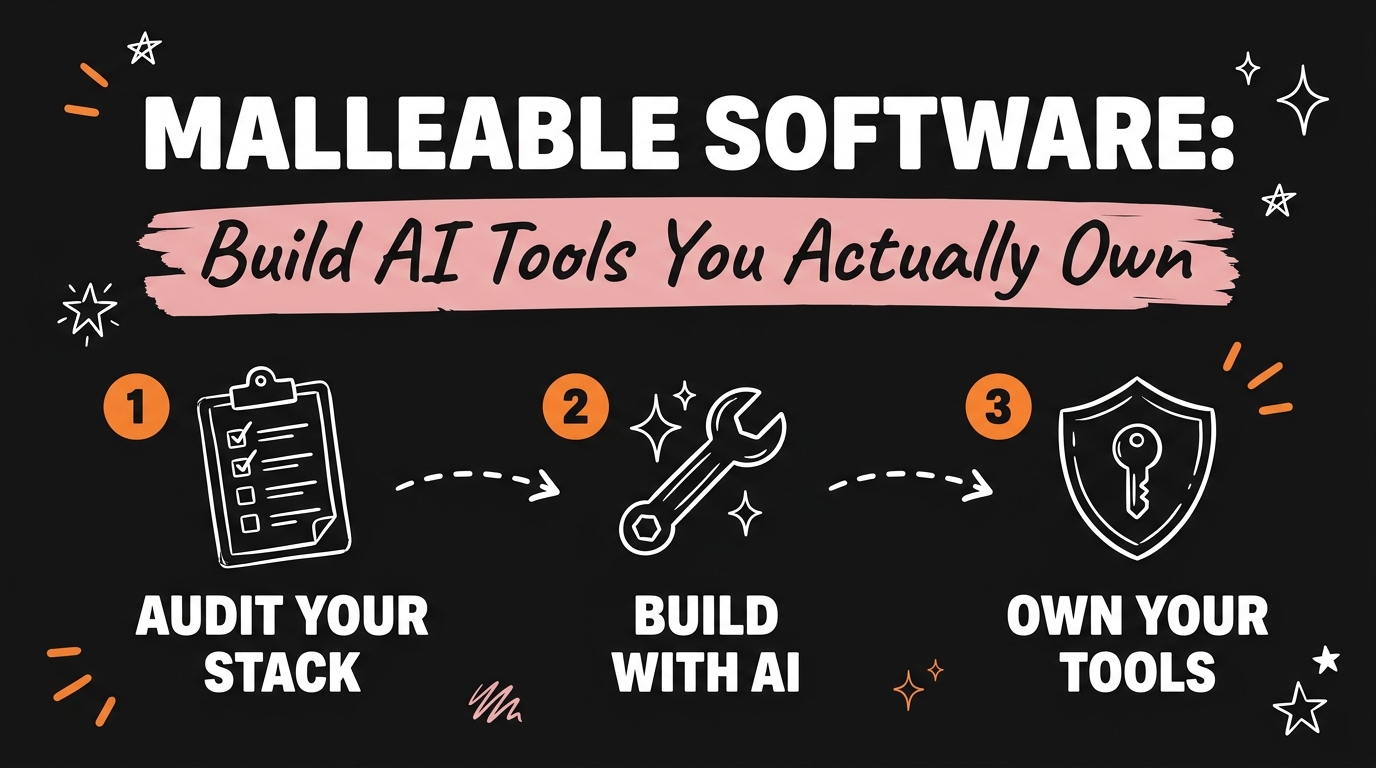
Most business owners are stuck using software built for someone else. The tools are close — but not quite right. You can’t change them, can’t extend them, and can’t make them talk to each other the way your actual workflow works. That’s the opposite of malleable software, and it’s costing you hours every week.
In this post, I’ll break down what malleable software actually means, why it matters for creators and entrepreneurs right now, and how AI tools like Claude Code are making it possible for anyone — no traditional coding background required — to build software that bends to their business instead of the other way around.
Get the Free Malleable Software Playbook
I put together a practical playbook that walks you through auditing your current tools, identifying where custom AI systems can unlock more flexibility, and the exact prompts to start building. It’s everything I couldn’t fit in the video.
Get the free Malleable Software Playbook →
What “Malleable” Actually Means
Malleable means shapeable. A piece of clay is malleable — you can push it, pull it, form it into whatever you need. Traditional SaaS software is the opposite: rigid, fixed, built for the average user and not your specific situation.
Malleable software is software you can modify. It adapts to your workflow, your data structure, your naming conventions, your team’s process. When your business changes — and it will — your software changes with it.
This isn’t a new idea. Developers have always had this power. What’s new is that AI tools have made it accessible to everyone. You don’t need to hire a dev team or spend months learning to code. You need a clear idea of what you want to build and the right AI system to help you build it.
Why Traditional SaaS Keeps You Stuck
SaaS tools are built for the middle of the market. They’re designed to be good enough for most people, which means they’re rarely great for anyone specific.
The problems stack up fast:
- Workflow mismatch — You end up bending your process to fit the tool instead of the tool fitting your process.
- Integration walls — Getting two tools to talk to each other usually means a patchwork of Zapier automations that break the moment one platform updates its API.
- Lock-in — Your data lives in their system, on their terms. You can’t see it, export it, or use it across other systems without jumping through hoops.
- Cost creep — You’re paying for 80% of features you’ll never use, and the one feature you actually need is in the tier above yours.
The bigger your operation grows, the more painful this becomes. You’re not just using software — you’re managing a fragile stack of tools that were never designed to work together.
How Claude Code Makes Your Software Malleable
Claude Code is an AI coding agent — meaning it doesn’t just generate code snippets, it actively works inside your project, reads your files, makes changes, and runs commands. You direct it like a developer on your team who can also design the system architecture.
Here’s what that looks like in practice:
You describe what you need. “I want a dashboard that pulls my Airtable data, shows pending orders, and lets me update statuses with one click.” You don’t write code. You explain the business outcome.
Claude builds it. Claude Code reads your existing setup, understands the context, and builds the feature. It can create a new Next.js page, connect your API, write the data fetching logic, and style the UI — all in one session.
You own the code. Everything runs in your environment. The source code is yours. You can deploy it to a $5/month VPS, customize every line, and add new features whenever you need them.
The result is software that’s genuinely malleable — not because the platform gave you a settings panel, but because you can change the actual behavior of the system.
What Malleable Software Looks Like for Creators and Entrepreneurs
The shift becomes clearest when you look at what you can build instead of what you used to buy. Instead of paying for tools that are 70% features you’ll never use, you build lean systems designed specifically for your workflow. Instead of three apps that don’t talk to each other, you have one platform sharing the same data. Instead of a generic dashboard built for the average user, you have exactly the view your business actually needs.
I’ve mapped out the specific playbook for this — the audit process, which systems to build first, and the exact prompts to get started — but I kept it out of this post on purpose. The playbook is detailed, and I want you to have the full version, not a summary. It’s free — just grab it below.
Ready to Go Deeper? Meet Growth OS
If you want to see what malleable software looks like at scale — as a complete business operating system — this is what I’ve been building:
Growth OS — The AI Business Operating System You Own
One web application. Fifteen integrated AI systems. Start with 10 production-ready AI systems and receive 5 additional AI systems as they’re developed. Everything runs inside one platform — sharing the same data, the same AI context, and the same login. Customize every feature with Claude Code, own the complete source code, and host it for as little as $5/month.
This is the practical end point of everything in this post. Not a SaaS subscription. Not a tool you rent. A complete AI business operating system that you own and can shape to fit exactly how you work.
What to Do Next
Malleable software isn’t a trend — it’s the shift from renting tools to owning systems. And right now, with Claude Code and AI coding agents, the barrier to entry has never been lower.
Start with the playbook. It’ll walk you through auditing what you’re currently using, spotting the highest-leverage places to build something custom, and the exact prompts to get your first system running.
Download the free Malleable Software Playbook →
And if you’re ready to build a full AI-powered business operating system from scratch, come join us at Vibe Coding Mastery — where we build exactly this, step by step.