
How to Use Fable 5: 3 High-Leverage Moves Before Your Budget Runs Out
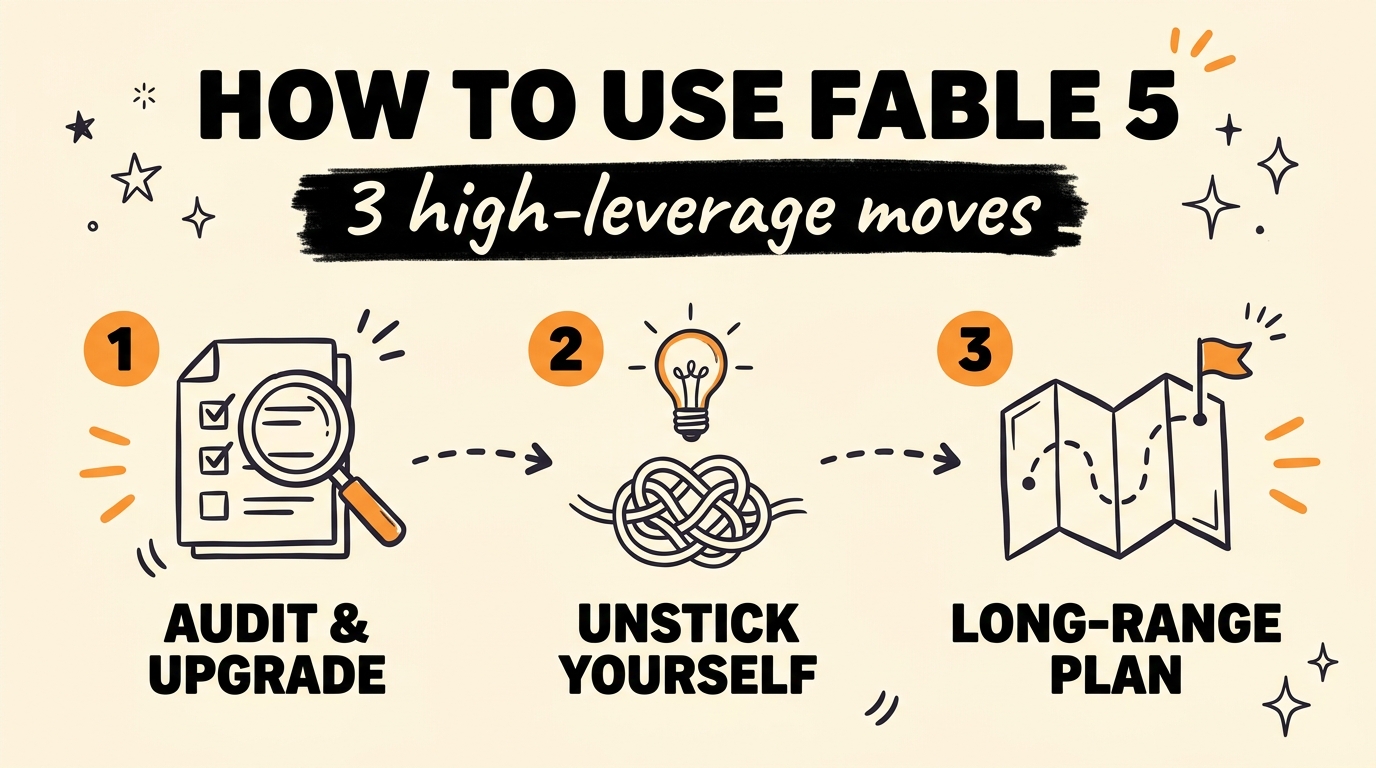
Fable 5 is the most capable model Anthropic has shipped — and it’s pay-per-use, so every single prompt costs you real money. That changes the game: you don’t want to burn it on the little stuff. In this post you’ll learn the three highest-leverage ways to use Fable 5, exactly what to prompt it for each one, and the one rule that lets you keep the value long after you stop paying for it.
Get the Free Guide
Want the deeper layer — the exact effort levels, the verification prompt that stops it from faking progress, and the memory and sub-agent setups that make Fable 5 actually reliable on long runs? That’s all in the free How to Actually Prompt Fable 5 playbook.
Get the free Fable 5 Prompting Playbook →
Why Fable 5 Changes How You Should Prompt
Most people test a new model on work they’ve already solved — a quick summary, a bit of code they could’ve written themselves. With Fable 5, that’s the wrong move. It’s built for problems that were previously too complex, long-running, or ambiguous for any model: end-to-end work that takes a person hours, days, or weeks. Because it’s premium and metered, the smart play is to point it at your hardest, most valuable problems, capture what it produces, and then run the everyday work on a cheaper model.
That reframe is the whole strategy. The three use cases below are the highest-return ways to spend a Fable 5 session — and for each one, I’ll give you the prompt to start from.
Use Case 1 — Audit and Upgrade Your Skills & Workflows
Fable 5 writes the most detailed, precise instructions of any model available. So the first thing to do is hand it your existing setup — your Claude Code skills, your system prompts, your repeatable workflows — and have it rewrite them into something sharper.
This is a one-time upgrade that pays off on every future run, even on cheaper models. You’re using the best model once to permanently level up the instructions everything else depends on.
What to prompt:
“Audit every skill, system prompt, and workflow in this project. For each one, identify where the instructions are vague, missing edge cases, or likely to be misinterpreted. Then rewrite each into the most precise, unambiguous version you can — preserving my intent but tightening the wording. Return the rewritten versions ready to paste in.”
Save every rewritten instruction. From here on, your regular model runs against better prompts — no extra cost.
Use Case 2 — Unstick Yourself on Problems You’ve Been Stuck On
Everyone has a graveyard of half-finished projects — the automation that kept breaking, the build that fell apart mid-execution, the thing you gave up on because no model could carry it to the finish line. Fable 5 is built exactly for those.
The trick is giving it full context. Export your old chats or notes on the problem into a single markdown file, then start a fresh project so the model isn’t fighting a cluttered thread. With the complete history in front of it and a clean slate, it can finally reason all the way through.
What to prompt:
“Here is the full history of a problem I’ve been stuck on [paste your exported markdown]. Read all of it, then work the problem end-to-end in this fresh session. Plan first, verify each step against real evidence, and don’t report a step done until you’ve confirmed it. If something can’t be solved, tell me why instead of guessing.”
Full context plus a clean project is often the difference between “close but broken” and actually solved.
Use Case 3 — Build a Long-Range Plan You Can Reuse
The third move is the most underrated: have Fable 5 build you a big, long-range plan. A 90-day content roadmap. A full product or project strategy. A step-by-step build plan for something ambitious.
A plan written by the best available model isn’t a throwaway output — it’s an asset. You generate it once, then execute against it for months on cheaper models. Long after you’ve stopped paying for Fable 5, that roadmap is still doing work.
What to prompt:
“Build me a detailed, long-range plan for [your goal — e.g. a 90-day content system, a SaaS launch, a client-onboarding workflow]. Break it into phases with concrete milestones, dependencies, and success criteria for each step. Write it so a cheaper model (or I) can pick up any single phase later and execute it without needing you again.”
That last line matters — you’re explicitly asking for a plan that outlives the session.
The One Rule That Makes All Three Pay Off
Notice the pattern: every use case ends the same way — save the outputs, then keep working on a cheaper model. Fable 5’s job is to do the expensive, high-judgment thinking once. The rewritten instructions, the solved problem’s approach, the long-range plan — those are durable artifacts. Capture them in a doc or your project files, and your day-to-day automation runs on cheap models against premium groundwork.
Use the best model where its judgment is irreplaceable. Bank the results. Run everything else lean.
Wrapping Up
Fable 5 is pay-per-use and premium, so don’t waste it on work you’ve already solved. Point it at the three highest-leverage moves — audit and upgrade your workflows, unstick your hardest problems, and build a reusable long-range plan — then save every output and execute on cheaper models for months. That’s how you get months of value from a handful of expensive prompts.
If you want the deeper mechanics — the effort levels, the progress-verification prompt, and the memory and sub-agent setups that make Fable 5 dependable on long autonomous runs — grab the free Fable 5 Prompting Playbook.
And when you’re ready to build full AI systems like this — not just one-off prompts — come Join the Vibe Coding Build → inside Vibe Coding Mastery.