
Claude Fable vs Opus: I Built 4 Real Apps to See If It's Worth 2× the Cost
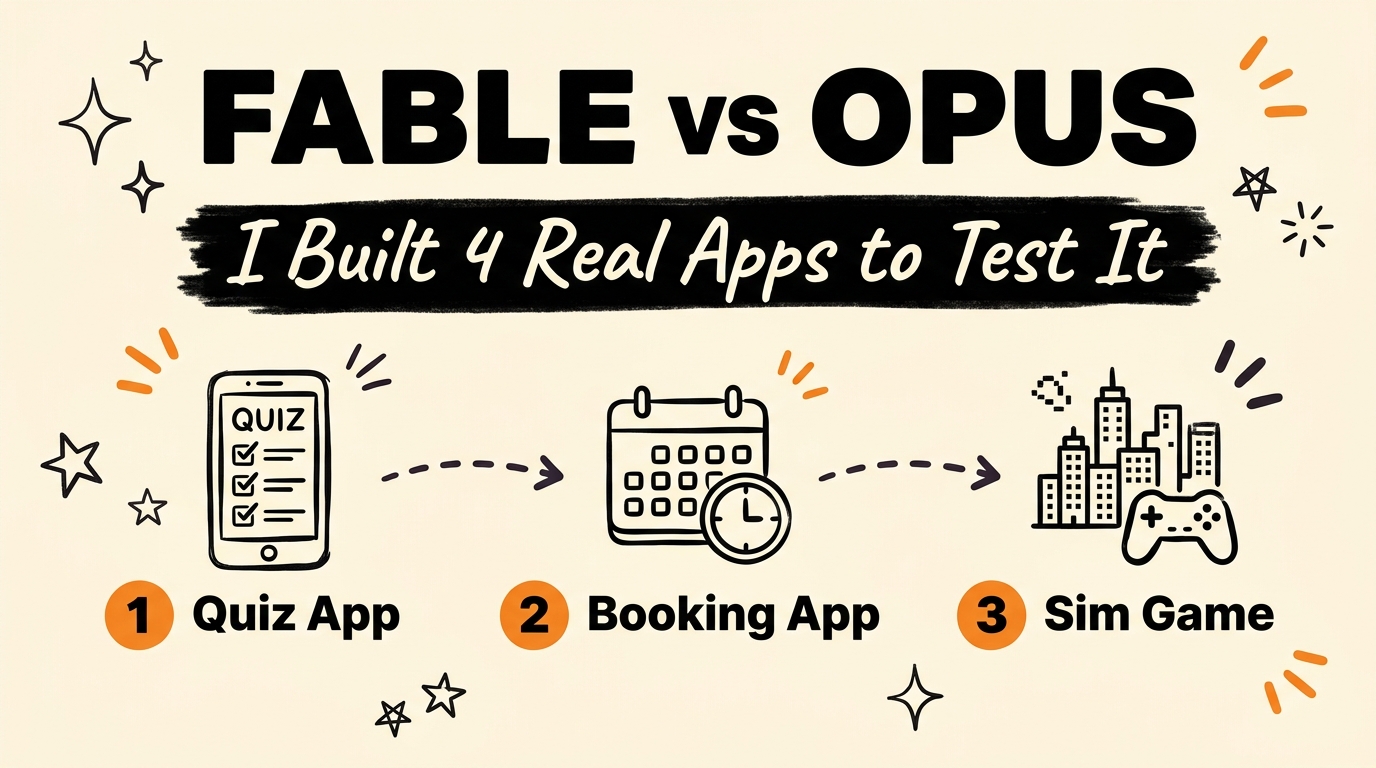
Claude just dropped Fable 5 — their most powerful model yet — and it costs roughly double what Opus does. So the obvious question for anyone building with Claude Code is simple: is Claude Fable vs Opus actually a real upgrade, or just a bigger bill?
I spent 24 hours building four real apps with both models, one prompt each, no hand-holding — and the gap was bigger than I expected. Here’s exactly what happened in each test, and how to run the same head-to-head yourself.
Get the Free Guide
I ran each app off a single prompt — and those four exact prompts (one per app) are all in the free guide so you can run the same Fable vs Opus test yourself, no guesswork.
Get the free Fable vs Opus Test Prompts Guide →
What Is Claude Fable 5?
Fable 5 is Anthropic’s newest and most capable model — positioned above Opus on reasoning, design taste, and the ability to carry a build several layers deeper than what you literally asked for. The trade-off is cost: Fable runs at roughly 2× the price of Opus per token.
For most chat tasks that premium is hard to justify. But building software is where a smarter model compounds — every better decision early saves you ten prompts of cleanup later. So instead of reading the benchmarks, I tested it the only way that matters for creators and founders: by shipping real apps.
The Test: 24 Hours, 4 Real Apps, One Prompt Each
The rules were strict so the comparison stayed honest:
- One prompt per app. No follow-ups, no “actually, can you also…” — whatever the model produced from a single prompt is what counts.
- No guidance. I didn’t describe the design, the features, or the structure beyond the core idea.
- Same prompt to both models. Fable 5 and Opus each got an identical brief, then I compared the results side by side.
Four apps, increasing in difficulty: a mobile quiz app, a booking app, a landing page, and a full simulation game. (I’m not pasting the prompts here — all four are in the free guide so you can copy them exactly.)
Test 1: Mobile Quiz App
First up, a simple mobile quiz app — one prompt, no guidance.
Opus built a solid, working app. Nothing wrong with it. But Fable went three layers deeper without being told to: it added features I never asked for — the kind of polish and edge-case handling you’d normally only get after a few rounds of follow-up prompts. From a single prompt, Fable was already anticipating what a real user would need.
Test 2: Booking App (Calendly-Style)
Next, a booking app in the style of Calendly. This one exposed a difference most people underestimate: design taste.
Fable chose better colors and avoided the generic “purple AI template” look entirely — that washed-out gradient aesthetic every AI tool defaults to. Opus produced a functional layout, but Fable’s looked like something you could actually put in front of customers without redesigning it first.
Test 3: Landing Page (Voice Dictation Tool)
Third test: a landing page for a voice dictation tool. Same single-prompt rule.
Fable added five sections instead of three — pricing, social proof, and feature breakdowns that Opus left out — and designed noticeably smoother animations. It wasn’t just doing more; it was making editorial decisions about what a high-converting landing page actually needs. That’s the kind of judgment you usually have to prompt for explicitly.
Test 4: SimCity-Style Simulation Game
The final stress test was the one that separated them completely: a SimCity-style simulation game.
Fable built moving traffic lights, realistic cars, people out on strolls, and a sun that actually tracks across the sky. It was a living, animated little world from one prompt. Opus built the same game — but everything was just boxes with labels. Functional, technically correct, and completely lifeless next to Fable’s version.
This is where the 2× cost stopped being a question. On a hard, open-ended build, the gap between the two models wasn’t incremental — it was the difference between a prototype and something that felt alive.
Is Claude Fable Worth 2× the Cost?
Here’s my honest take after 24 hours: for quick chats and simple edits, Opus is still plenty. But for building — especially anything design-heavy or open-ended — Fable earns the premium. It makes better decisions from less input, which means fewer follow-up prompts, less cleanup, and a result that’s closer to shippable on the first pass.
The real cost isn’t the per-token price — it’s your time spent correcting a weaker model. On that math, Claude Fable vs Opus tilts toward Fable the moment the build gets ambitious.
Want to run this exact test yourself? The four prompts I used — one for each app — are in the free guide. Drop them into Claude Code, switch the model, and watch the difference for yourself.
Get the free Fable vs Opus Test Prompts Guide →
If you want to go from testing models to actually shipping real apps with Claude Code, come build with us at Vibe Coding Mastery.